Showing posts with label Stock. Show all posts

Sunday, April 6, 2014

Food Diary - Saturday Night Dinner at Home

There are few things I enjoy more than catching up with friends at home over a good meal and a glass of wine. We were long overdue in catching up with our friend Kim (who actually only lives close by - isn't that always the way!) so last night we did something about that and invited him over for a moochy Saturday night dinner at home.

To start, I came up with a dish that is basically posh eggs on toast - a crunchy base of toasted rustic garlic rubbed bread, piled with Prosciutto, fresh greens, a soft poached free range egg - and finished off with luxurious black truffle butter sauce. The combination of the crunchy bread, velvety eggs, salty Prosciutto and fresh greens created a gorgeous contrast of textures - and that decadent black truffle butter sauce created an entree that was wickedly good.


 Soft Poached Egg on Garlic Toast
With Prosciutto, Greens and Truffle Butter Sauce


I recently purchased a small bottle of Tetsuya's Black Truffle Salsa - which is designed to be used to create the famous truffle butter that he serves in his restaurant. I've been lucky enough to dine at Tetsuya's quite a few times now (in fact we are heading there in a couple of weeks for our wedding anniversary dinner) and the truffle butter is something we always look forward to. Lots of other people clearly think so too, so he now sells the base of it so that people can create their own. I decided to make up a batch of the butter and just warm it through, to create a luxurious sauce. The result was an eye rollingly delicious entree.

If you want to get your hands on some of Tetsuya's Black Truffle Salsa for yourself, you can find it in good gourmet stores, or online. If you are searching for it, it comes in a tiny jar that looks like this -


For the basis of main course, I chose something that I haven't cooked at home for ages - venison. Regular readers of Gourmet Goddess would know that I'm a big fan of game meat, and in the last week or so had been thinking that I wanted to get my hands on some venison to create a dish using Autumn produce. I used a beautiful piece of venison loin, which I marinated in olive oil, some garlic, a splash of raspberry vinegar, crushed juniper berries, pepper and allspice.

I then seared the meat in a very hot pan and transferred it to a 200C oven to cook for 10 minutes. After resting the meat, I carved it and served it with a rich, velvety puree of cauliflower and potato (I used the Dutch Cream variety), roasted beetroot ( which I cut into uniform circles with a cookie cutter, to improve the presentation), toasted hazelnuts, beetroot leaves and a jus that I made from beef stock and Pinot Noir jelly (similar to redcurrant jelly, but made with Pinot grapes) and flavoured with bay leaves from my garden. Yum.


Loin of Venison with Cauliflower & Potato Puree, 
Roasted Beetroot, Hazelnut and Pinot Noir Jus


Venison is a fantastic flavoursome and super lean meat that is not hard to cook with, as long as you choose the right cut for the kind of dish you are making. I chose the loin of the venison, which is cooked for a short time and served medium rare, to rare. The only real thing that you really need to watch for is overcooking. It isn't a meat that is really suited for people who like their meat well done, so if you are making it at home, know your diner's preference. Cooking venison to a well done order will just result in a grey, tough piece of meat. A waste of really excellent produce.

I decided not to make a dessert and to serve a selection of cheeses, fresh pear and some quince paste - but after what was a rich entree and main, we decided that we were all satisfied, and that a cheese plate would just be overkill. The cheese platter might end up being Sunday lunch.

If you like game but have never had a go at cooking venison at home, I really encourage you to give it a try. It isn't hard and makes a great key ingredient for a special meal, whether you are sharing it with guests or not.

******


Sunday, April 29, 2012

Creamy Mushroom Ragout with Polenta

The weather has been cooling down here in Sydney and on Saturday I was really in the mood for some Autumn comfort food. Looking in the fridge I had a whole pile of gorgeous seasonal mushrooms and thought I would create a dish around them. At first I thought maybe a soup or pasta, but then remembered that I also had a packet of organic polenta in the cupboard, and for me, nothing says comfort like that delicious northern Italian staple. If you have never used it, polenta is a basically pure dried corn meal used in cuisines all around the world from Italy to Mexico.

I decided on a mushroom ragout to serve with my polenta, using 6 kinds of fresh mushrooms, as well as a handful of dried porcini mushrooms to ramp up the flavour. Using dried mushrooms is a great way to boost the richness of the dish but they are also a great ingredient to have in your cupboard for use in stocks and sauces too. They keep pretty much forever in an airtight jar. I used porcini mushrooms in this dish, but I always have dried shitake and forest mushrooms in the pantry as well.

 Mushies!

The variety of mushrooms work really well with the creamy golden polenta, both in flavour and texture contrast. As well as tasting fabulous, polenta is also very good for you, being packed with complex carbohydrates (so it has a very low GI) lots of fibre, a great source of vitamin A and C, iron, thiamin and zinc. It is also low in fat. Traditionally it is served with lots of grated parmesan and butter, however I have omitted this in my recipe as I wanted the dish dish to be the healthier version. Feel free to add some butter and grated parmesan though if the mood takes you - it really is delicious. I do find though, that if you are serving it with a very flavoursome accompaniment, then the cheese and butter aren't really necessary.

Polenta is a great alternative to pasta for those people who need to avoid wheat in their diet and is very versatile. See my hints at the bottom of the recipe for ideas about what to do with your leftovers if you have any. It may even be worth making extra so that you can make another dish the next day.

This ragout and polenta is a great vegetarian dish, but you can also serve it as a side dish with roasted red meat, pork, poultry - or game such as rabbit, venison or quail. It looks beautiful served on a large platter, but if you want to go really traditional, serve it poured onto a big chopping board in the middle of the table, for the ultimate rustic effect.


Creamy Mushroom Ragout with Polenta


You will need:
For the polenta - 1 cup polenta (cornmeal),3 cups water or stock,salt, pepper.

For the ragout - around 500g fresh sliced mushrooms - choose as many varieties as you can get your hands on - shitake, swiss brown, pine, field, button, oyster, enoki, porcini. 1/2 cup dried mushrooms (I used porcini) 1 large finely sliced onion, 2 cloves finely chopped garlic, 1 tablespoon olive oil, 2 teaspoons balsamic vinegar, salt, pepper, 1 tablespoon soft cream cheese (I use the low fat Philadelphia brand one in the tub), 1/2 cup stock (vegetable, beef or chicken) 1 tablespoon chopped fresh herbs - I use parsley, chives, thyme.


Method: First, place the dried mushrooms in a small bowl and cover with boiling water. Allow to soften while you make the polenta.

To cook the polenta, bring the water or stock to the boil in a heavy-based saucepan. Gradually add the polenta in a slow, thin, steady stream, whisking constantly until all the polenta is incorporated into the water. Whisking ensures that the polenta is dispersed through the liquid as quickly as possible and doesn't clump.

Reduce heat to low and simmer, stirring constantly with a wooden spoon for 10 - 15 minutes or until the mixture thickens and the polenta is soft. To test whether the polenta is cooked, spoon a little of the mixture onto a small plate and set aside to cool slightly. Rub a little of the polenta between 2 fingers to see if the grains have softened. If the grains are still firm,cook the polenta for a little longer. Whisk through the butter and parmesan and season with salt and pepper. Adjust seasonings as required. Cover and set aside.

Now to the mushrooms. Drain the dried mushrooms well and chop them finely. Heat a pan and add the olive oil. Add the onions and garlic and cook gently until the onions are transparent and soft. Add the dried and fresh mushrooms (except the enoki mushrooms if you are using them - these cook very fast so don't add them until the last moment) Cook the mushrooms for a minute or so until they start to soften. Add the stock, balsamic and a little salt and pepper. Simmer until the stock starts to reduce - a couple of minutes.

Stir through the cream cheese until it is well incorporated. If the mixture is a bit too thick, add a small amount of water or stock. Add the enoki mushrooms if you are using them and stir through until just softened. Taste the ragout for seasoning and adjust accordingly.

Give the polenta one last whisk to ensure it is smooth and serve with the mushroom ragout. Top with fresh herbs and serve.

Note: If you have leftover polenta, turn it out on a plate and put it in the fridge for the next day. Cut it into slices, pan fry and serve with grilled veges, nepolitana sauce and parmesan - or cut it into batons and fry it in hot oil to make polenta chips. When it is set, it can easily be cut into whatever shape you like. I have used it to make into little bite sized discs as a base for Italian inspired canapes, or little cubes to dip in gorgonzola sauce. Pretty much anything you can think of - it is super versatile.

Serves 2 as a main meal or 4 as a side dish.


******


Thursday, July 8, 2010

Comfort food - old school style

It has been rather chilly here in Sydney and nothing is nicer in the cold weather than a really hearty, old fashioned soup. My original plan was to make a soup based on vegetables, barley and ham hocks - but when I went to the butcher they had run out of ham hocks (everyone else in the neighbourhood must have had a hankering for soup making too) The lovely butcher suggested he cut me some pieces of osso bucco as an alternative and that it would work really well with the barley.

Well, the lesson here ladies and gentlemen, is listen to the butcher. He was dead right, and this soup turned out beautifully. Absolutely bursting with flavour, full of delicious nutty tasting barley and lots of veges. Not only was it tasty, warming and satisfying - it was also super healthy. I cooked the soup for around 3 hours, so it isn't one to whip up after work or when you are in a hurry. It does however, freeze beautifully, so do a big batch on the weekend and freeze it in portions to have whenever you fancy.

I love the addition of silverbeet to this soup - please note that we are talking silverbeet here (the big tall dark green leaved stuff with the white stalks. Also known as Chard) not English spinach. English spinach is far too delicate for this super robust dish. If you really hate silverbeet, then just leave it out - but I love my greens and I think it really adds extra flavour and texture to this soup. I also prefer the soup to be quite thick, but add more stock or water if you prefer it a bit lighter. I was so happy with the addittion of the osso bucco to this soup I will be doing it this way from now on. Try it and see if you agree....


Beef and barley soup

You will need: 2 medium carrots, 1 parsnip, 1 leek (use only the white part), 2 brown onions, 3 or 4 stalks of celery, 1 bunch silverbeet, 2 medium potatoes, 3 pieces of beef osso bucco (with the bone still attached of course! You want that precious marrow), 1 cup dried barley, 2 litres beef stock (I just used the commercial kind from the supermarket, but if you have homemade stock, then use it), 3 cloves garlic, 2 bay leaves, 2 tablespoons olive oil, 1 bunch fresh continental parsley, a couple of pinches of cayenne pepper, salt and pepper to taste.

Method: Wash the carrots, parsnip and potatoes thoroughly. Leaving the skins on, (more flavour and more vitamins!) dice them into pieces 1-2 cm in size. If you want super chunky soup, then by all means cut them bigger. Now cut your celery into pieces, around the same size as your other veges. Set your veges aside.

Cut the really thick white stalks from the silverbeet and then slice the green part - you can cut it quite thickly as it will shrink a lot once you cook it. Set the silverbeet aside. Slice the leeks, dice your onions and finely chop the garlic.

Heat the olive oil in a large soup pot. Add the onions, leek and garlic and cook them on a medium heat until they are soft and slightly transparent. Add the carrot, parsnip, potato, celery, bay leaves, cayenne pepper and  season with a generous pinch of salt. Cook the veges for about 10 mins, stirring regularly so they do not stick to the bottom of the pot. Add the osso bucco and cook for another 5 minutes.

Add the beef stock and top the pot up with water so that it only leaves about 3 fingers width of space between the liquid level and the top of the pot. Cover the pot until it comes to the boil and then turn it down to a very gentle simmer. Allow to simmer like this, stirring occasionally for about 2 hours.

After 2 hours, add the barley and stir it in well. Simmer for a further 45 minutes and then add the silverbeet. Let the soup cook for another 15 mins or so. If it gets too thick, just add some hot water. Taste for seasoning and add salt and pepper as required.

By this stage most of the meat - if not all - should have fallen off the bones. Remove the meat and bones and chop any larger pieces of the meat into smallish pieces. If there is still marrow in the bones, then remove it and chop it up too. Return all of the meat (minus the bones) to the pot.

Just before serving, chop up the fresh parsley and fold it through the soup, keeping a little in reserve to put on the top. Serve with crusty bread.

******

Thursday, June 3, 2010

Paris Cooking School

Hi everyone - well this weary traveller is back from a month away, still a bit jetlagged and adjusting to having to get up for work every morning and be back in the real world again. I had a fantastic time away, and over the next few weeks you will be seeing and hearing a little of some of the food experiences I had in my travels. I have returned home with a whole swag of inspiration and ideas for dishes, as well as some new skills (I now know how to butcher a whole rabbit!) and some great kitchen hints and techniques. My trip took me to London, Inverness, Glasgow, Edinburgh and Paris - all very different places with different produce and different food traditions. But I thought I would begin with an account of my cooking school experience in Paris.

Starting the day with a cafe au lait before heading to cooking school

I woke really early on my second day in Paris very excited that I was heading for cooking school that morning. Students had all been instructed to meet outside the Jules Joffrin train station where we would meet our instructor, Chef Pino Ficara. We would then walk to the nearby market to purchase our fresh ingredients and then up the hill to the school itself for class.

Our first market stop was a fromagerie (cheese shop) where Pino gave us a lesson in the various kinds of cheesemaking techniques which had us all spellbound. Cheesemaking is such a scientific and magical process and many recipies and ways of working have been around for literally hundreds, if not thousands of years. I learned about how the fromageries were set up, in order to have the cheese at it's best, and also to prevent the stinky cheeses from cross contaminating the more delicate ones- a lot of the cheeses are not refrigerated and virtually all of the cheese is made with raw milk. In Australia, it is illegal to sell raw milk products (an exception was only recently made that allowed 2 kinds of Roquefort to be imported, but our laws are ridiculously antiquated) so I was so excited at the prospect of having a raw milk cheese fest.


A tiny sample of the huge selection of cheeses I came across in the fromagerie


And a fest it was. I tasted no less than 15 kinds of cheese (there must have been a couple of hundred in the shop) - all hand made - some made by monks, some aged in caves, some preserved in straw, cheese soaked in wine or basted in beer, cheese from cow milk, sheep milk and goat milk, bright yellow hard cheese and creamy milky white cheese, cheese that tasted of clean air and pure milk, cheese that was sticky and deliciously foetid, cheese covered in ash or studded with wild herbs and lavender,tangy and crumbly cheese, velvety white goat cheese so delicious it made your eyes roll back in your head! The shop itself was so beautifully set up. The aproned staff expertly cut and lovingly wrapped our selections and we headed to our next stop - the charcuterie (butcher)


Some of the poultry and game on sale at the charcuterie

If you are squeamish about raw meat or you are only used to buying your meat wrapped in sanitised plastic packets, then you might have been a bit freaked out on entering the butcher shop. Much of the meat such as poultry and games is sold in one piece, with head, feet/ claws all still attatched. Not only are these used for stock, but they also allow you to ensure that the meat is fresh. The selection available was so exciting - including pheasant, squab pigeon,quail, duck, about 7 or 8 varieties of chicken, venison, rabbits and hares. I love game and particularly rabbit so I was thrilled when it was decided that we would cook rabbit that day. We bought two whole rabbits (skinned, but with the head and all left on, as well as the liver - we had plans for that) which were wrapped up by the butcher in brown paper and string and we headed down the street to the fishmonger.


Oysters and fresh live crustaceans for sale at the local fishmonger


The selection of fish, and particularly shellfish was spectacular - so many varieties of oysters! (they are never pre opened, they are sold closed or you can get the fishmonger to shuck them for you), mussels and clams, periwinkles, live crabs of all kinds, langoustines, prawns and lobsters - also smoked fish, snails and fresh kelp. The first thing that strikes you is that the fish doesn't smell fishy - it is SO fresh that it just smells like seawater. Everything looked so superb - we chose two large silvery bream that we planned on turning into a starter for our menu.


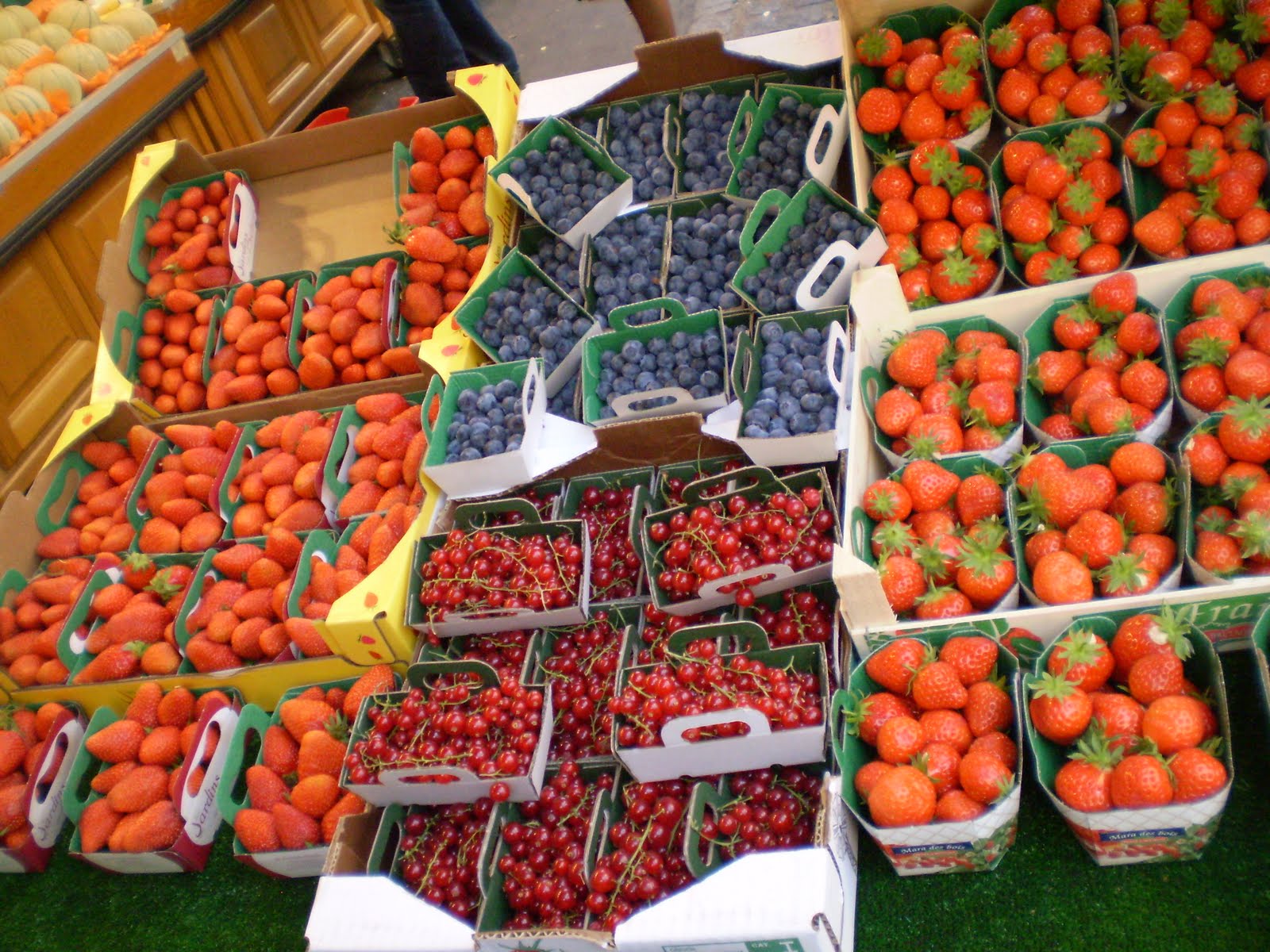
Delicious berries, destined for our kitchen


Pretty fresh radishes and onions at the greengrocer


Next stop, the vegetable market- a riot of brightly coloured reds, greens,oranges. Tight bunches of scarlet radishes, bundles of emerald green and creamy white asparagus, all kinds of herbs displayed in large wicker baskets big enough to put your washing in - and the berries! That luscious aroma of fresh strawberries again, cherries, melons... Everything looked so abundant and beautiful. We decided on what we wanted to serve with our dishes and came away with bunches of sweet smelling herbs, celery root (celeriac), wild asparagus (which I had never seen - delicate, with thin stalks and small pretty tapered ends), endive (witlof), fresh carrots, eschallots, garlic, a punnet or two of ruby coloured raspberries and some sweet smelling strawberries.


Gorgeous fresh artichokes for sale


Final stop on the way back to school was an artisan bread maker (who Chef said is quite mad and obsessed with perfection - but makes the best bread in Paris - using a centuries old woodfired oven, grinding his own flour with a stone grinder and keeping his sourdough culture literally locked in the basment because he is scared someone will steal it!) The bread! Oh.....the bread! The best I have ever eaten in my life. We chose bagettes, walnut bread, and a fruity rye loaf that we planned to serve with our cheeses. We munched on still warm bagettes happily as we walked up the hill to school in the sunshine.


Fresh bread from the artisan bakery - baked 4 times a day


The class was amazing and I learned so much - so many great tips and techniques as well as learning more about the actual chemistry of what happens to ingredients when you combine them or treat them in a particular way. It was also SO much fun. I learned to make proper creme patissiere (the beautiful custard that goes into choux puffs or tarts, and also butchered my first whole rabbit, which was like conducting surgery. In Australia they never have the feet or head left on!) I was in culinary heaven as we put our menu together - a starter of oven roasted bream filllets baked on a thick bed of fresh herbs and served with creamed celeriac, the main course of braised rabbit with sauteed endive, wild asparagus, carrots and eschallot confit and a dessert of a strawberry and raspberry tart, with an almond pastry base and vanilla creme patissiere. We also enjoyed a superb cheese platter between main course and dessert and lots of lovely french wine to wash it all down with. An unforgettable experience.

Here is what I cooked that day:


A starter of herb baked bream, celeriac puree and mache

Braised saddle of rabbit with wild asparagus, confit eschallots and witlof

Fresh fruit tart with almond pastry and creme patissiere


Because it doesn't get dark until 10pm, I decided to jump on a boat after class and cruise the Seine, enjoying the warm weather and that beautiful golden evening sunshine that turns everything buttery yellow. I cruised past the palaces, the tower, the Louvre - along the embankments where people were enjoying a glass of wine or lying on the grass. I felt so lucky to be there and to have had such a wonderful day. When I eventually made it back to Montmartre, I decided that I would have a picnic on my balcony for dinner, (I had eaten a lot during the day so I didn't want a big restaurant dinner) so I simply bought a small bagette (warm from the oven - they bake 4 times a day here!) ,a small piece of succulent cooked duck (in Paris butchers sometimes sell meat they cook on the premises), some raspberries and a little pot of creme freche to dip them in and ate them on my very Parisian wrought iron Juliet balcony overlooking the street as the sun went down. What a great day.


Chef Pino Ficara and I in the Montmartre kitchen

I have fallen completely and utterly in love with Paris - can you blame me??? I am already planning an extended return trip in 2011. In the meantime, I plan to hone my new skills and appreciation for French food in my own kitchen. Bon appetit!

*****


Monday, April 5, 2010

Gorgeous Game

I am a big fan of all kinds of game meat and with the arrival of beautiful Autumn produce, it is the perfect time to indulge in both! I had a couple of duck marylands in the freezer and thought I would team these with some lovely organic produce from the Addison Road Organic Market for dinner on Sunday night. I bought a bag of French Charlotte potatoes (a variety I had never tried before), some sugar snap peas, asparagus and a bunch of stunning ruby red beetroot.

I love the earthiness and sweetness of beetroot and it tastes fabulous when cooked until sticky and sweet with balsamic vinegar, lots of nutty roasted garlic and caramelised onions. It is the perfect addition to a dish of simply roasted duck. To prepare the duck, I simply took 2 marylands and rubbed them with garlic salt (made with 2 teaspoons of Maldon sea salt, a pinch of cayenne and 2 crushed cloves of garlic) I let the duck rest for about 2 hours in the fridge, before roasting it gently for about 35 minutes (let it rest for 10 mins before serving) For the sauce, I just used the pan juices, some homemade chicken stock and a tablespoon of redcurrant jelly whisked together and thickened slightly.

Below is the recipe for the caramelised balsamic beetroot - be warned, it is extremely moreish! I like the beetroot in reasonably large chunks, but you can also cut the beetroot small, so that it forms more of a relish. It can be served warm or cold and is great with all kinds of game - venison, duck, rabbit or quail. It will also work well with lamb or roasted pork if you aren't that keen on game.

Here is Sunday night's offering.....


Roasted duck marylands
with roasted balsamic beetroot and redcurrant gravy


Roasted Balsamic Beetroot

You will need:
5 or 6 small, fresh beetroot, 1 large red onion cut into thick slices, 6 cloves garlic peeled and cut into half, 1 tablespoon extra virgin olive oil, 2 tablespoons balsamic vinegar, 1 tablespoon caster sugar, 1/2 teaspoon sea salt, a couple of pinches of cayenne pepper, generous pinch black pepper.

Method:
Cut the stalks from the beetroot and wash them well. Place them in a pot and cover them with water. Bring them to the boil and allow to simmer for about 10 minutes.

Drain the beetroot and run them under cold water. When they are cool enough to handle, gently rub off the outer layer (it will come away easily) Cut the beetroot into quarters.

Preheat the oven to 200C.

Combine the beetroot with all of the other ingredients. Cook for about an hour or until the onion and beetroot caramelises. Give the mixture a stir every 20 minutes or so.

Serve warm or cold with baked or roasted meat.

*****


Saturday, January 9, 2010

By special request....

Here at Gourmet Goddess we are all about satisfying the culinary cravings of those we care about, so this week when my friend and fellow food lover - the lovely Emily - asked me if I had a recpe for a mediterranean style chicken casserole dish, I promised her that I would whip one up on the weekend and post the recipe. This chicken dish I have chosen is very rustic and the flavours are bold, with the addition of fennel, olives and capers. The sauce also contains anchovies. Now, if you hate anchovies, don't go all skittish on me (you are already screwing up your nose, aren't you??) Anchovies add a beautiful piquant quality to the sauce and I promise you that it won't taste even remotely fishy. They really do add something special to the dish, so don't be tempted to leave them out. I really love capers in a whole range of dishes and they really work well with mediterranean flavours. Generally I prefer to use the salted capers - you just need to rinse the salt off them before use. If you can only get the ones in vinegar, that's fine - just drain them well. The smaller capers are much nicer than the really large ones too, so look out for the smaller "baby" capers.

This dish can be made ahead and is actually even more delicious the next day. Perfect for entertaining if you want a "set and forget" meal that will not keep you away from your guests. It is also ideal for freezing, which is what I am doing with the batch I've made tonight. It is gorgeous as a pie filling too. Put the mixture in a dish or in individual ramekins and whack some puff pastry on the top. Cook until the pastry is puffed and golden and presto! Mediterranean chicken pie. This casserole is lovely with polenta, green vegetables such as broad beans or zucchini or with crusty, garlic grilled bread.

So, here you are Em - hope you enjoy this one....


Mediterranean chicken with olives and capers


You will need: 1kg boneless chicken thighs, 2 tablespoons plain flour, 2 tablespoons mild paprika, 1/4 teaspoon cayenne pepper, 2 large onions, 1 small fennel bulb, 4 cloves garlic, 1/2 cup roughly chopped pitted olives (I used a mixture of red and green), 1 tablespoon capers, 1 bay leaf, 4 anchovies finely chopped, olive oil, 1 litre chicken stock, 1 tin crushed tomatoes, 1 tablespoon balsamic vinegar, salt and pepper.

Method: Trim the excess fat from the chicken thighs and if the chicken thighs are all in one large piece when you buy them, cut them in two. Combine the plain flour, cayenne, a generous amount of black pepper and 1 tablespoon of the paprika - coat the chicken well in that mixture. Heat some olive oil in a casserole dish on the stovetop and brown the chicken till golden, a few pieces at a time. Don't overcrowd the pan - you want to brown the chicken at this stage, not stew it. Put the chicken aside.

Slice the onion and fennel (only use the white part of the fennel bulb). Heat a splash of olive oil in the pan and cook the fennel and onion until it starts to soften. Add the bay leaf, garlic, anchovies, olives and capers and combine well. Add the chicken, stock, tomatoes, balsamic and 1 tablespoon paprika. Bring to a simmer and then cover the pan and transfer it to a moderate oven.

Cook for 1 hour with the lid on, stirring a few times during the cooking. After the 1 hour mark, taste for seasoning and add salt and pepper if required. Turn the oven up high and cook the chicken for another 20 minutes so that the sauce reduces furter before serving. Serves 4-6 people.

****


Monday, December 28, 2009

Viva l'italia !

Spaghetti bolognaise would have to be one of my favourite comfort foods and it is a dish that most people really love. I have two distinct ways of making the bolognaise sauce for this - the first is the "I just got home from work and I'm starving and I want dinner asap" version which is pretty quick and basic, and the recipe I would like to share with you today, the "Lovingly simmered as if made by your own Italian Nonna" version. This version should be allowed to slow cook for at least a couple of hours. It takes its cue from the more traditional approach to bolognaise and contains two kinds of meat - beef and pork. The flavour is beautiful and that extra time makes all the difference!

Today I decided to go a step further and make a large tray of lasagne using the bolognaise sauce - I don't make it that often and usually cook it with the aim of freezing it in one serving portions for a quick and easy dinner. I have included my lasagne recipe too, if you are so inclined.

I have a real soft spot for Italian cuisine - I am not Italian (often people ask me if I am!) but when I was growing up, my parents had close friends from the north of Italy - the Bertollini's who ran an old school Italian family restaurant in the town of Seymour in country Victoria. They often took care of me and I remember playing in the kitchen of the restaurant where the old lady, Nonna would hand make pasta for the restaurant. She was always in the kitchen and I don't think I ever saw her without her apron on. Although I was very young, they made a huge impression on me. They were loud, loving and chaotic and food was always the centre of their world. I remember the incredible aromas from that kitchen, beautiful northern Italian dishes - I still remember the sublime smell of wild rabbit cooked with garlic and rosemary and slow cooked sauces and ragu. My most vivid childhood food memory is standing on a chair so that I could reach the table and Nonna showing me how to hand roll Gnocchi by rolling it off the fork, a skill I took into my adult life and into my own kitchen.

I spent so much time with them that I actually spoke Italian before I spoke English and would apparently speak Italian at lightening speed to my bemused non- Italian speaking Australian mother. I would also drink the Bertollini's homemade wine like a little Italian kid. My mother tells the story that I usually protested when they tried to top my glass up with water - the older you are, the more wine and the less water you are supposed to get. Bambinos only get a little splash of wine. I didn't like this at all and would tip the watered down wine into the sink and yell Vino! Vino! until I got a higher wine/water ratio. My love of wine clearly carried through to my adulthood. I blame the Bertollini's!!

Nonna's Slow Cooked Bolognaise Sauce

You will need: 500g minced beef, 500g minced pork, 2 medium carrots, 3 sticks celery, 2 large onions, 2 tablespoons finely chopped parsley stalks (no leaves) , 3 large cloves finely chopped garlic, olive oil, 700ml Passata (or 2 x cans crushed tomatoes), 1 1/2 cups red wine (I use Shiraz), 1litre beef stock, 1/4 teaspoon cayenne pepper, 1 tablespoon mild paprika, 1/4 teaspoon freshly ground nutmeg, 3 teaspoons sugar, salt, pepper.

Method: Chop the carrots, celery and onions into small cubes. Heat a splash of olive oil in a large saucepan and then add the carrot, celery, onion and parsley stalks. Cook on a medium/high heat for about 5-7 minutes, until the onion starts to turn transparent. Add the mince and garlic. Cook for another 5-7 minutes until the meat is all browned. Add the paprika, cayenne and nutmeg and combine well.

Turn up the heat and add the red wine. Combine well with the meat mixture and let it bubble vigorously for about 5 minutes. Add the Passata (or tomatoes), sugar and plenty of salt and pepper. Mix well and then add the stock. Bring the pot to the boil and then reduce the heat until bubbles are only just breaking the surface of the sauce. Simmer for 2 - 3 hours, stirring occasionally to ensure that the sauce does not stick on the bottom.

If the sauce becomes too dry, top up with a little bit of water as you go. When the sauce is cooked, taste it for seasoning and adjust if neccessary (this will usually depend on how salty - or not - your stock is) If your minced meat is not super lean, there may be a thin layer of oil on the top of the sauce when it cools. Simply spoon this off before serving, or dividing into containers for freezing.

This recipe will make enough for a large Lasagne, or 4-6 takeaway containers of sauce to freeze. Each container will serve 2-4 people if serving with spaghetti or other pasta.


 Lasagne al Forno (Baked Lasagne)


You will need: 1 quantity of slow cooked bolognaise sauce (see above), 4 cups milk (plus a little extra), 2 heaped tablespoons plain flour, 2 heaped tablespoons butter, 1/2 cup grated cheese (mozzerella is good), 1/3 cup grated parmesan cheese, Generous pinch cayenne, 1/4 teaspoon freshly ground nutmeg, salt, pepper, 1 pack fresh lasagne sheets.

Method: In a saucepan, melt the butter over a medium heat. Add the flour and using a whisk, combine well. Allow the flour and butter to cook for a few minutes, being careful not to brown or burn the mixture. The flour will take on a pale appearence as it cooks. This is what is called a white roux, and is the basis for your bechamel sauce.

Remove the pan from the heat and add about a quarter of the milk, whisking constantly until it is smooth. Keep adding the milk until it is all combined. Return the pan to the heat and cook on a medium heat until it starts to thicken. Add the cayenne, nutmeg and season with salt and pepper. If the sauce becomes too thick, whisk in more milk. When it is the consistency of custard, remove from the heat and stir in the parmesan cheese. Set aside.

Heat the oven to 240C. Line a baking dish with baking paper. Put a few tablespoons of the bolognaise in the bottom of the dish, then a layer of pasta, another layer of bolognaise and another of pasta. Now add half of the bechamel sauce, and complete the layers of pasta and bolognaise until you are left with a pasta layer on top. Add the rest of the bechamel to the top and sprinkle with cheese. Cover with a piece of baking paper.

Cook for 45-50 minutes, until the pasta is tender and the lasagne is browned on the top. Allow to stand uncovered for at least 10-15 minutes before serving. Don't be tempted to try to cut it into portions the second it is out of the oven - it needs time to rest. It will be easier to handle and will look much better if you are patient. This dish is ideal for making the day before serving (just reheat) and is suitable for freezing. Serves 8-10 people.

****

Sunday, December 13, 2009

Luscious Louisiana

"There is no dish which at the same time so tickles the palate, satisfies the appetite, furnished the body with nutriment sufficient to carry on the physical requirements, and costs so little as a Creole Gumbo. It is a dinner in itself, being soup, piece de résistance, entremet and vegetable in one.”

-William H. Coleman,
Historical Sketch Book and Guide to New Orleans and Environs


Gumbo originated in New Orleans, Louisiana and to me represents multiculturalism in a pot. It combines the flavours of Africa, Spain, Native America and France to produce a dish full of flavour, that owes its heritage to many people and many places. It is said that there are as many ways to cook Gumbo as there are cooks, so you will see many different versions. It is a thick soup/stew that contains rice (if there is no rice actually in it, it is always served with rice on the side) to this, broth and other ingredients are added. Some use pork, chicken, sausage and seafood, some use just vegetables. The Cajun folks tend to make a darker, heavier Gumbo that has a roux (flour and browned butter) as a base and does not use tomatoes. The Creole style uses tomatoes, and okra (which does the same job as the roux, binding the dish) The Native Americans use leaves from the Sassafrass tree to do the same.

My Gourmet Goddess version tonight borrows from the Creole tradition and uses purely seafood. I chose flathead fillets, clams, calamari and prawns. I also used chilli in the dish, which is not usually done - it is usually served seperately in the form of chilli sauce (like Tabasco) so people can add as little or as much as they like. I was just cooking for myself tonight, and I know what I like so I just put the chilli right in there! Feel free to use it or not.

Some notes about the ingredients....


Tabasco Smoked Chipotle Sauce - This particular Tabasco isn't that easy to find in Australia, although if you live in the city, the David Jones Foodhall does stock it in their "American" section. You can also buy it online. USA foods out of Melbourne is a good source if you live in Australia. http://www.usafoods.com.au/
 If you can't get it, don't worry - just use normal Tabasco from the supermarket. It will not the have the same slightly smoky undertaste, but it will still taste good.


Okra - If you are not familiar with this vegetable, it is a long green pod native to West Africa and is related to the Hibiscus plant. Although it originated in Africa, it spread with the slave trade and is now eaten all over the world, throughout Asia and the Middle East, America, Nepal and India. When you slice it, it releases a clear sap that helps to thicken any dish that contains it. The texture when cooked is pleasantly gelatinous and it soaks up flavours particularly well. I think that it is at its best in Gumbo.


So, to tonight's dish - this amount will serve 4 people and you can freeze it , but if you do be sure to remove the meat from the clams first and disgard the shells.


Gourmet Goddess Creole Gumbo

You will need: 1 large onion, 1 medium carrot, 1 stalk celery, 1 large potato, 1 tin diced/crushed tomatoes, a couple of handfuls of okra (chop them into three), 1 bay leaf, 1 tablespoon paprika, 4 cloves chopped garlic, 1/2 tablespoon sugar, 1 red chilli chopped finely, 2 white fish fillets chopped into chunky pieces (I used flathead this time), a couple of handfuls of clams in the shell, 6 shelled raw king prawns, 1 medium calamari/squid cut into rings, 1 litre fish or vegetable stock, 1 cup cooked white rice, Tabasco Sauce (the smoked chipotle version if you can get it, otherwise just use the normal one) salt and pepper, olive oil, fresh parsley to serve.

Method : Dice the onion, carrot, celery and potato into small cubes. Heat a splash of olive oil in a deep pan and add the chopped vegetables, along with the bay leaf, garlic and chilli. Cook on a medium heat until the onion starts to turn translucent. Add the okra and combine well. Let it cook for a couple of minutes, then add the tomatoes, tabasco, sugar and stock. Allow to simmer for 15minutes, then add the cooked rice. Simmer for another 5 minutes.

Add the seafood, combine well season with salt and pepper. Put the lid on the pan and let the seafood cook for about 5 minutes, stirring once during the cooking. The dish is ready when the clams open up (disgard any that do not) Taste the dish and adjust the seasoning if you need to.

Serve in soup bowls with fresh parsley.

*


Saturday, October 31, 2009

French? Fantastique!

One of my great pleasues in life is spending time with old friends over a few bottles of good wine, great conversation and of course, delicious food. Last night my gorgeous friends Justin and Marek joined Michael and I for a long overdue catch up over a french inspired meal (see, watching Julie and Julia at the cinema the other day has brought out the francophile in me!) I was fortunate to have the day off, so I had the luxury of plenty of time. As well as the shopping and dinner preparations, I also took the opportunity to make a batch of chicken stock - I used some on the day but also put some in the freezer to use later. It is such an easy thing to do if you have time - home made stock has a flavour that a mass produced, bought product just can't match. I do keep commercial stock in the pantry but there is nothing like one that you have made yourself.

So, what did I cook? I decided to include a couple of french classics as well as some of my own dishes with a french twist. I consulted my trusty beaten up copy of Larousse Gastronomique for inspiration and came up with the following menu.

Spinach, cheese and chive souffle
Watercress and radish salad with toasted hazelnuts and garlic prawns (served with a Dijon dressing)
Coq au vin with potato galette and sauteed asparagus
Rhubarb and strawberry meringue parfait

I have never cooked a souffle before so I was a bit nervous about it. I have never been someone who really uses recipes - I prefer to cook by taste and touch and to let my instincts guide me. With a dish like a souffle however, you pretty much need to follow a recipie. I actually found it hard to do what I was told (I can already hear my mum saying - what's new?!) but the result was absolutely beautiful. Light as air and delicious. Unfortunately, in my haste to get the souffles straight from the oven to the table before they start to deflate, I forgot to take a photo of them. Sorry everyone. I do think that they deserve a blog entry of their own, so I will make them again and post the recipe and photos when I do (very soon, I promise!)

The next course was a light salad - quite simple but full of flavour and great textures. I combined watercress, thinly sliced radish, toasted hazelnuts and prawns that I marinated in olive oil, garlic and paprika. The dressing was olive oil, a touch of honey, Dijon mustard, white wine vinegar, salt and pepper. This dressing combo works well with many kinds of salads and is a real favourite. The crunch of the hazelnuts was really delightful and there is a great contrast of nuttiness and the peppery taste of the radish and watercress.

The main course was the classic Coq au vin. I prepared this earlier in the day and let it cook for a long time. At the last moment, I removed the tender chicken from the pot and finished the sauce off with a splash of cream and then let the sauce reduce and thicken. I based the recipe on one of the versions of Coq au vin in Larousse Gastronomique but tweaked it a little (if you are interested, it is the Madame Maigret's recipe. It is listed in the book under Coq au vin)

My guests really loved the tenderness of the chicken and the rich, moreish sauce. I served the chicken with lovely fresh asparagus which I sauteed with just a touch of sea salt and pepper. I also made a potato galette - a layered cake of potato and leek that I cooked for a very long time until the potato was deeply caramelised and crisp on top. To make the galette, you slice the potato very thinly and layer it with sliced leeks. Season each layer with pepper and a small amount of salt, brushing the layers with a little melted butter. I used a cake tin lined with baking paper to cook it in.

For dessert, I revisited a dish that regular readers will remember from back in July - a parfait of rhubarb, meringue and strawberries. I had saved a batch of the rhubarb/strawberry mixture from back in July and had frozen it, so it is the same mixture you will see in the photos for my entry on the 25th July. Check out my archives from July for the recipe. I used delicious organic cream on the top this time with some vanilla extract and a touch of caster sugar.

The boys and I all had a wonderful evening - there was plenty of laughter and great conversation, as well as some very good red wine provided by the generous Justin and Marek. I love my friends :)

I was very happy with how the four dishes worked together and even happier to have conquered my very first souffle. Julia Child would have been proud :) In the words of the great lady herself - Bon appetit!!!

*